
The 4 development plans
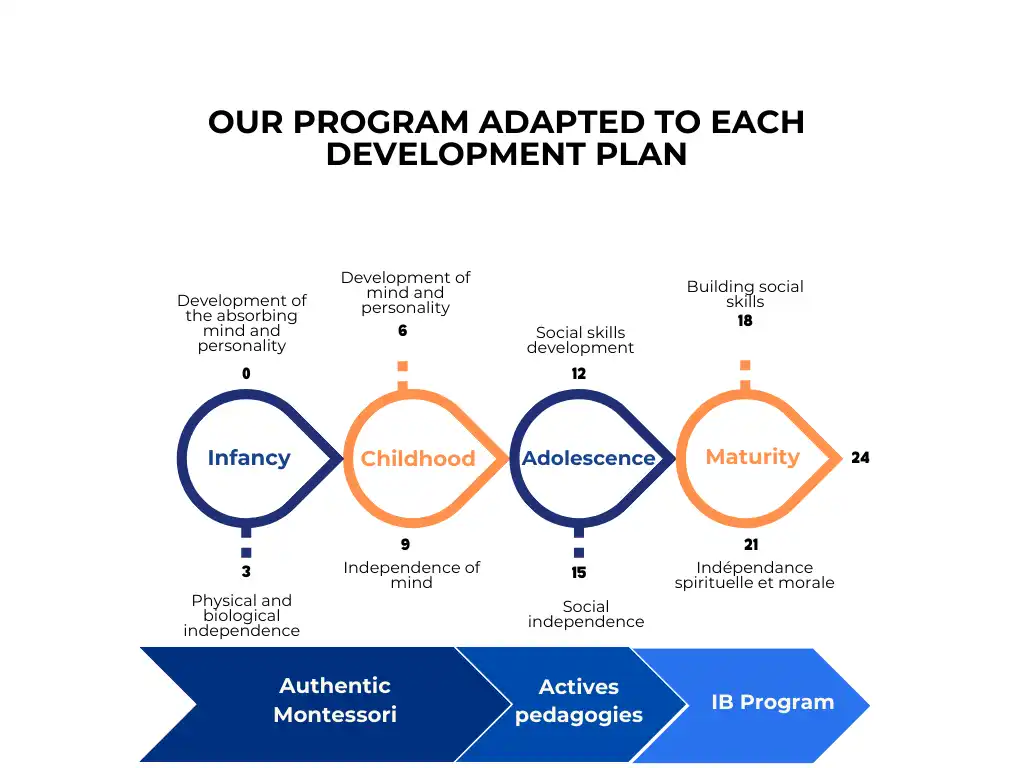
Maria Montessori was responsible for describing human development in terms of 4 distinct phases, known as "development plans".
Key Principles
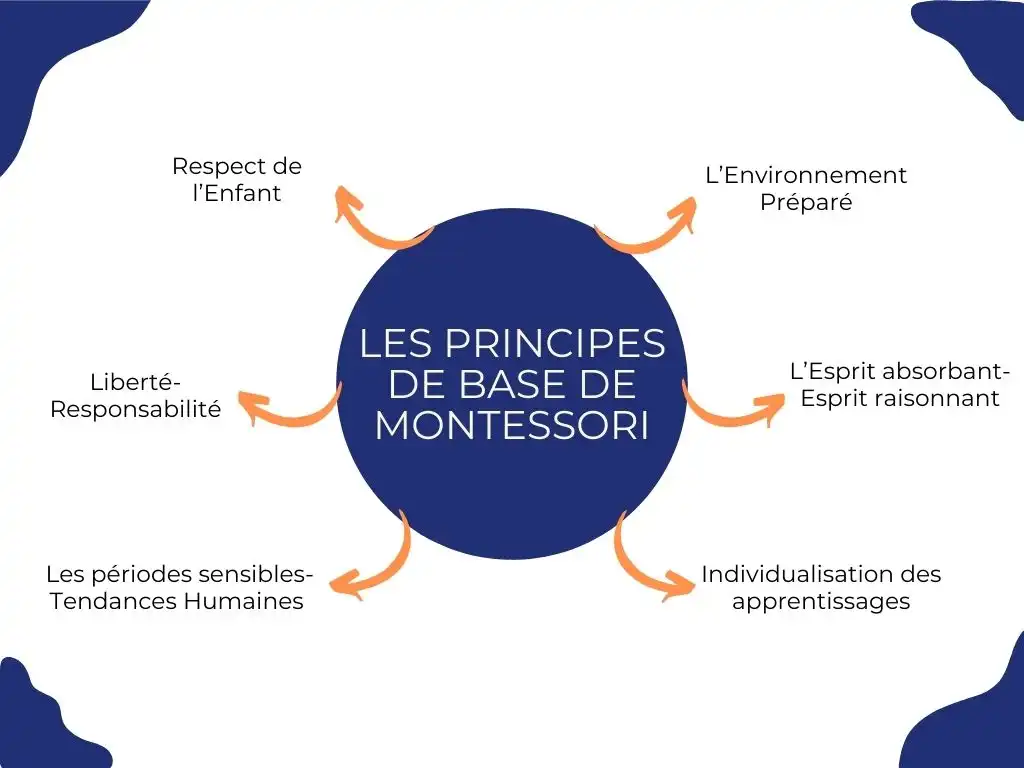
Respect for children
- Children are seen as beings in their own right, with their own personality, on the same level as adults ("horizontality").
- Children have specific psychological characteristics depending on their stage of development (0-3 years, 3-6 years, 6-12 years), which adults take into account in the way they support them.
- The adult sets the framework by gaining the child's trust, not imposing by status or force ("verticality").
Absorbing mind/reasoning mind
- Between the ages of 0 and 6, children unconsciously absorb everything around them sensorially; all their senses are involved, they perceive the visible, the sensory and the invisible (emotions, inner states).
Sensitive periods / human trends
- In the course of their development, all children go through the same sensitive periods (from 0 to 6 years) and human tendencies (from 6 to 12 years), during which they develop specific skills, at different times and for different lengths of time; educators are trained to identify these and to offer activities in the prepared environment that nurture the development of these skills.
- Sensitive periods and human tendencies include order, language, the mathematical mind, social development, exploration, etc...
Prepared environment
- The educator's job is to set up a living environment that responds to the characteristics of the child at each stage of development (0-3 years, 3-6 years, 6-12 years): he or she will endeavour to set up and maintain 5 environments: physical (the classroom), temporal (the course of the day), dynamic (rules, protocols and rituals), emotional and social-moral.
Individualised learning
- The educator links the child with activities in the environment according to his or her own development and interests. In this way, each child progresses at his own pace, according to his own needs and interests; he takes responsibility for his own learning and seeks the help he needs from his peers and the teacher.
Freedom - Responsibility
- Children develop at their own pace within a clear framework defined at the outset, which they help to establish and develop (depending on their age); this framework is based on respect for themselves, for others and for the prepared environment provided.